
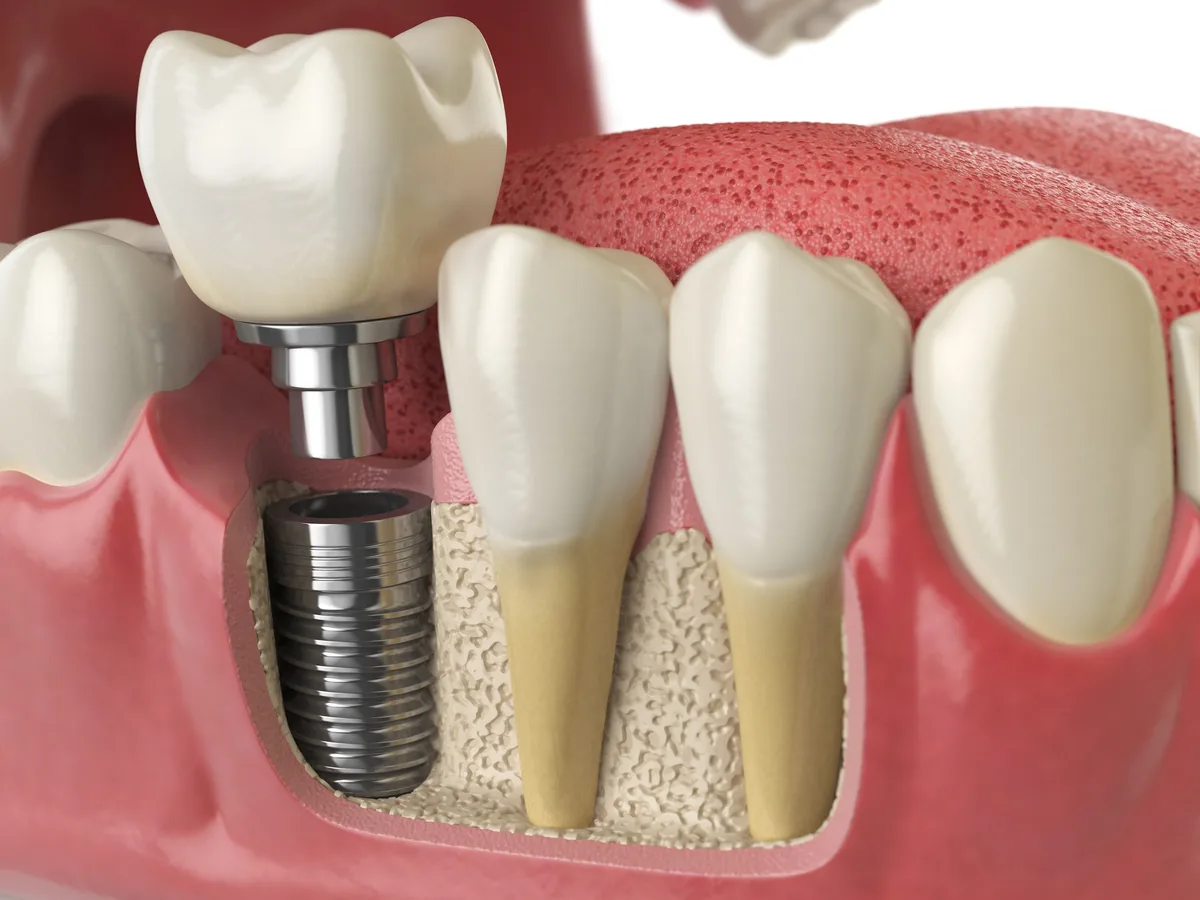
Replace One Missing Tooth With a Natural-Looking Dental Implant
A single tooth implant can replace one missing tooth without requiring healthy neighboring teeth to support the restoration.
The treatment consists of a dental implant placed into the jawbone to replace the missing tooth root, followed by a custom dental crown that replaces the visible portion of the tooth. The crown is carefully designed to complement the shape, size, shade, and proportions of your surrounding teeth.
At Beverly Hills Cosmetic & Implant Center, Dr. Tamir Shams plans, places, and restores single tooth dental implants within one practice. With 19 years of dental implant experience and more than 2,000 implants placed, Dr. Shams combines 3D treatment planning, implant surgery, restorative dentistry, and cosmetic considerations to create an individualized tooth-replacement plan.
- What Is a Single Tooth Dental Implant?
- Why Replace a Missing Tooth?
- Benefits of a Single Tooth Implant
- Dental Implant vs. Bridge for One Missing Tooth
- Who Is a Candidate for a Single Tooth Implant?
- What to Expect During Single Tooth Implant Treatment
- Can a Dental Implant Be Placed the Same Day as an Extraction?
- Comfort & Recovery
- How Much Does a Single Tooth Implant Cost in Beverly Hills?
A 3D scan, a clear answer on which option fits you, and a written plan with timeline and cost. No obligation.
What Is a Single Tooth Dental Implant?
A single tooth dental implant is a treatment designed to replace one missing tooth from the root to the visible crown.
The restoration generally consists of three components:
Dental implant: A small biocompatible titanium post surgically positioned in the jawbone to replace the missing tooth root.
Abutment: A connecting component between the dental implant and the final crown.
Dental crown: The visible replacement tooth, customized to complement your surrounding natural teeth.
Together, these components create an independent tooth replacement that does not rely on neighboring teeth for support.
Dental implants can be used to replace teeth lost because of decay, fracture, trauma, periodontal disease, failed dental treatment, or extraction when the patient is an appropriate candidate.
Why Replace a Missing Tooth?
Even one missing tooth can affect more than the appearance of your smile.
Depending on its location, tooth loss may affect chewing, speech, bite relationships, and the position of surrounding teeth. The jawbone in the area of the missing tooth can also change over time because the natural tooth root is no longer present to provide stimulation.
Replacing a missing tooth can help restore the space while supporting comfortable function and maintaining the alignment of your smile.
Benefits of a Single Tooth Implant
For appropriate candidates, a single dental implant provides several advantages.
Replaces the Tooth Without Relying on Neighboring Teeth
A dental implant creates its own foundation within the jawbone. Healthy adjacent teeth generally do not need to be prepared simply to support the implant restoration.
Helps Maintain Bone Around the Implant Site
Dental implants transfer functional forces into the surrounding jawbone and can help maintain bone around the implant site.
Fixed Tooth Replacement
An implant-supported crown remains securely attached and is not removed by the patient like a removable partial denture.
Natural-Looking Appearance
Your implant crown can be customized according to the size, shape, shade, and proportions of the surrounding teeth.
This is particularly important when replacing a visible front tooth.
Familiar Daily Care
A single implant crown can generally be brushed similarly to a natural tooth. Cleaning around the implant and maintaining healthy surrounding gum tissue remain important for long-term implant health.
Long-Term Treatment Option
Dental implants are designed for long-term tooth replacement. Their longevity depends on oral hygiene, gum and bone health, bite forces, smoking, medical conditions, professional maintenance, and other individual factors.
Dental Implant vs. Bridge for One Missing Tooth
Patients replacing one missing tooth often have two potential fixed options: a single dental implant or a traditional dental bridge.
The primary difference is how the replacement tooth is supported.
Single Tooth Implant
A dental implant is placed in the missing-tooth site and supports an individual crown. Neighboring healthy teeth generally do not need to be reshaped to support the restoration.
Traditional Dental Bridge
A conventional bridge typically uses teeth on either side of the missing space for support. These neighboring teeth are prepared for crowns, with a replacement tooth connected between them.
Neither treatment is automatically right for every patient.
A traditional bridge may be appropriate in certain situations, particularly when neighboring teeth already require significant restorative treatment. A dental implant may be preferable when the adjacent teeth are healthy and sufficient bone is available for implant placement.
Dr. Shams can evaluate your teeth and explain which approach is appropriate for your specific situation.
Who Is a Candidate for a Single Tooth Implant?
A single tooth implant may be appropriate for someone who has lost one tooth because of:
- Tooth decay
- Dental trauma or injury
- Tooth fracture
- Periodontal disease
- Failed previous dental treatment
- Tooth extraction
- A congenitally missing tooth
Implant candidacy also depends on the condition of your gums, available jawbone, medical history, bite, oral hygiene, and other clinical considerations.
You do not necessarily need perfect bone volume at the beginning of treatment. If bone has been lost around the missing tooth, bone grafting may sometimes be recommended to create adequate support for implant placement.
Dr. Shams uses clinical examination and 3D imaging to determine whether a dental implant is appropriate.
What to Expect During Single Tooth Implant Treatment
Every case is different, but single tooth implant treatment commonly follows several stages.
Consultation & 3D Scan
Dr. Shams evaluates the missing-tooth area, neighboring teeth, gums, bite, and available jawbone.
CBCT imaging provides three-dimensional information about the treatment area and surrounding anatomical structures.
Personalized Implant Planning
Using your examination and imaging, Dr. Shams determines the appropriate implant position with the planned final crown in mind.
If extraction, bone grafting, or another preparatory procedure is necessary, it will be incorporated into your treatment plan.
Dental Implant Placement
The implant is surgically positioned in the jawbone using local anesthesia. Sedation options may also be available when appropriate.
Healing & Osseointegration
The implant then undergoes osseointegration, the biological process in which the surrounding jawbone heals around and integrates with the implant.
This commonly requires several months, although the timeline varies according to the treatment site and individual healing.
Final Dental Crown
After the implant has achieved appropriate healing and stability, the final crown is attached.
The restoration is designed with attention to fit, bite, tooth shape, shade, and its relationship to the surrounding smile.
Can a Dental Implant Be Placed the Same Day as an Extraction?
In certain cases, immediate implant placement may be possible.
This means the damaged or failing tooth is removed and the dental implant is placed into the extraction site during the same appointment.
However, immediate implant placement is not appropriate for every patient.
Bone condition, infection, gum health, implant stability, the location of the tooth, and other clinical factors must be evaluated before determining whether an implant can be placed immediately.
In other situations, the extraction site may need time to heal before implant placement.
Dr. Shams will recommend the sequence most appropriate for your individual case.
Comfort & Recovery
Dental implant surgery is performed using local anesthesia to maintain comfort during the procedure, and sedation may be available when appropriate.
After implant placement, temporary soreness, swelling, bruising, or tenderness can occur. Recovery varies according to the location of the implant, whether an extraction or bone graft was performed, and individual healing.
Many patients can resume routine activities relatively quickly, but Dr. Shams will provide personalized postoperative instructions and advise you when to return to specific activities.
How Much Does a Single Tooth Implant Cost in Beverly Hills?
The cost of replacing one tooth with a dental implant varies according to the individual treatment required.
Factors that may affect cost include:
- Dental implant placement
- Abutment
- Final implant crown
- Tooth extraction when necessary
- Available jawbone
- Bone grafting when necessary
- Location of the missing tooth
- Complexity of treatment
- Restorative materials
Rather than advertising a generalized “low cost,” Beverly Hills Cosmetic & Implant Center provides a personalized written treatment plan so you understand the recommended procedure and associated costs before treatment begins.
Monthly financing options are available for qualified patients.
Frequently Asked Questions About Single Tooth Implants
A single dental implant is one common fixed option for replacing one missing tooth because it replaces the missing tooth without requiring neighboring healthy teeth to support the restoration. A traditional dental bridge may also be appropriate in certain situations. The best option depends on your oral health, bone, neighboring teeth, and treatment goals.
One dental implant can be used to replace a single missing tooth. The implant replaces the missing root and supports an individual dental crown.
Each has advantages. A single dental implant generally does not require healthy neighboring teeth to be reshaped for support, while a traditional bridge relies on adjacent teeth. However, a bridge may be appropriate when neighboring teeth already need crowns or when implant surgery is not recommended.
Sometimes. Immediate implant placement may be possible when the extraction site, bone, gum health, and other clinical conditions are favorable. Other patients benefit from allowing the site to heal before implant placement.
Bone loss does not automatically prevent implant treatment. Depending on the amount and location of bone loss, bone grafting may help create adequate support for a dental implant. A 3D scan allows Dr. Shams to evaluate the site.
The timeline varies. After implant placement, the implant commonly requires several months to integrate with the jawbone before the final crown is placed. Immediate implant placement and other treatment protocols may alter the overall timeline.
The final implant crown is customized to complement the surrounding teeth in shape, size, proportion, and shade. Particularly in visible areas of the smile, restorative planning considers both function and aesthetics.
Dental implants are designed as a long-term tooth-replacement option, but longevity varies. Oral hygiene, gum and bone health, bite forces, smoking, medical conditions, and regular professional maintenance all influence long-term implant health. The crown may eventually require maintenance or replacement even when the implant itself remains healthy.
Replace Your Missing Tooth With Confidence
If you are missing one tooth or have a tooth that may need to be extracted, a single dental implant may provide a fixed, natural-looking replacement.