Dental Bone Grafting & Bone Augmentation in Beverly Hills
- Home
- Procedures
- Bone Augmentation
Rebuilding Jawbone to Support Dental Implant Treatment
Successful dental implant treatment depends on having adequate jawbone in the appropriate location to support the implant.
When bone has been lost because of missing teeth, periodontal disease, infection, trauma, or previous extractions, dental bone grafting and bone augmentation can help rebuild or preserve the foundation needed for future implant treatment.
At Beverly Hills Cosmetic & Implant Center, Dr. Tamir Shams evaluates jawbone anatomy using 3D imaging and determines whether bone augmentation is necessary as part of an individualized dental implant treatment plan.
Depending on your needs, treatment may involve socket preservation, ridge augmentation, guided bone regeneration (GBR), or another grafting approach designed around the location and extent of the bone deficiency.
- What Is Dental Bone Augmentation?
- Why Does Jawbone Loss Occur?
- Do I Need a Bone Graft Before Dental Implants?
- Bone Augmentation Options
- Ridge Augmentation
- Guided Bone Regeneration (GBR)
- What Type of Bone Graft Material Is Used?
- Can Bone Grafting and Dental Implant Placement Be Done at the Same Time?
- What to Expect During Bone Augmentation
- Recovery After Dental Bone Grafting
- Bone Augmentation as Part of Comprehensive Implant Planning
A 3D scan, a clear answer on which option fits you, and a written plan with timeline and cost. No obligation.
What Is Dental Bone Augmentation?
Bone augmentation refers to procedures used to preserve, rebuild, or increase bone in an area of the jaw.
One of the most common reasons bone augmentation is performed in dentistry is to create adequate bone for dental implant placement.
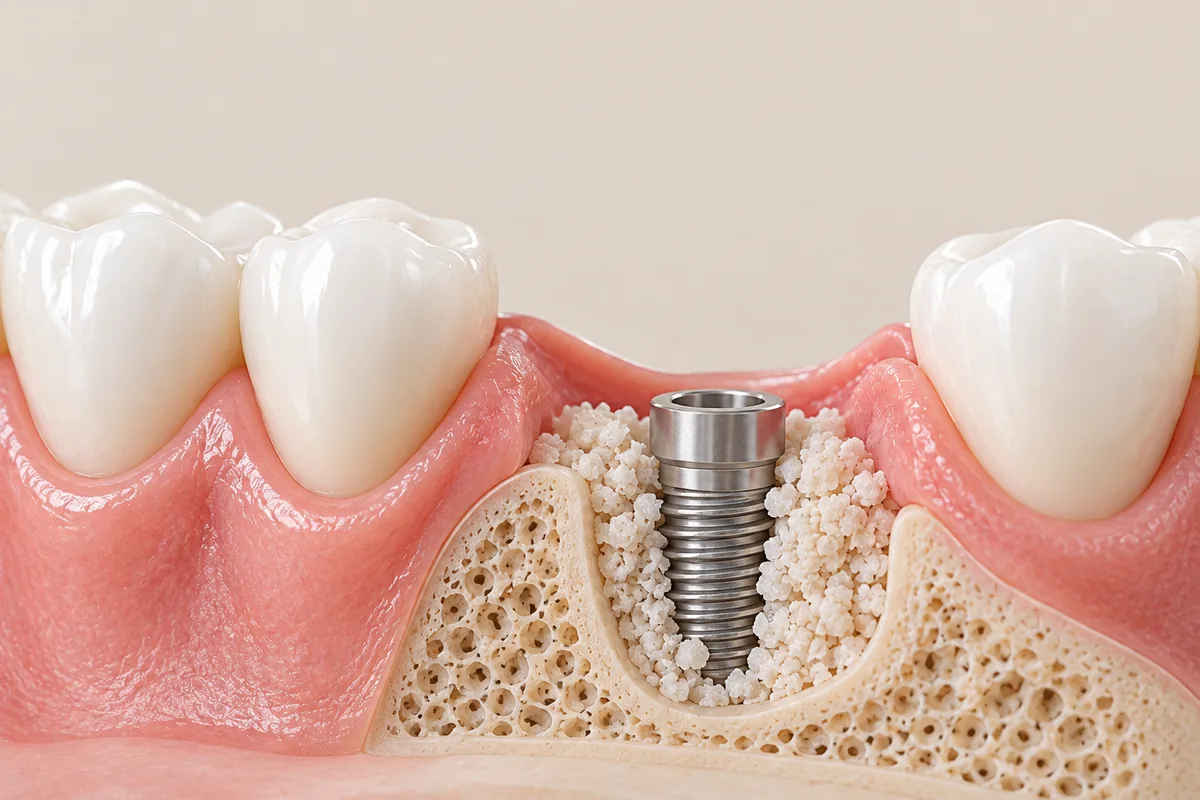
A dental implant is positioned within the jawbone and depends on the surrounding bone for support. When the available bone is too narrow, too short, or otherwise insufficient for the planned implant, a bone graft may be recommended.
Bone graft material is placed in the deficient area to provide a framework that supports the body’s natural bone-healing process.
Over time, new bone can develop within and around the grafted area, creating a more suitable foundation for implant treatment.
Why Does Jawbone Loss Occur?
Jawbone can change in volume and shape for several reasons.
Common causes include:
- Long-term tooth loss
- Previous tooth extraction
- Periodontal or gum disease
- Dental infection
- Trauma or injury
- Bone loss around failing teeth
- Long-term denture use
- Individual anatomy
After a tooth is removed, the bone that previously surrounded and supported the tooth root naturally begins to remodel.
The amount and pattern of bone change vary by patient. When significant bone loss has occurred, there may not be enough bone in the desired location to predictably support a dental implant without additional treatment.
This is why evaluating bone early—particularly when a tooth needs to be extracted—can be important when future dental implant treatment is being considered.
Do I Need a Bone Graft Before Dental Implants?
Not everyone receiving a dental implant needs bone grafting.
Some patients already have sufficient bone to support an implant, while others may need additional bone in a specific area.
Dr. Shams evaluates factors such as:
- Height and width of the available jawbone
- Location of the missing tooth or teeth
- Number of implants planned
- Condition of the extraction site
- History of infection
- Gum and periodontal health
- Surrounding anatomical structures
- Type of implant restoration planned
A CBCT scan provides three-dimensional information about the jaw and helps determine whether adequate bone is available for implant placement.
If augmentation is recommended, Dr. Shams will explain the type of grafting procedure, when it should be performed, and how it fits into your overall implant treatment plan.
Bone Augmentation Options
Different bone deficiencies require different treatment approaches. The procedure recommended depends on your anatomy and the amount and location of bone that needs to be preserved or rebuilt.
Socket Preservation
Socket preservation, sometimes called an extraction-site bone graft, is performed at the time a tooth is removed.
After extraction, bone graft material is placed into the tooth socket to help preserve the dimensions of the area as it heals.
Socket preservation may be recommended when a dental implant is planned for the future but cannot or should not be placed at the time of extraction.
The goal is to limit bone loss in the extraction site and help maintain a more favorable foundation for future implant placement.
Ridge Augmentation
The alveolar ridge is the portion of the jawbone that surrounds and supports the teeth.
After tooth loss, infection, trauma, or prolonged denture use, this ridge may become too narrow or otherwise deficient for the planned implant.
Ridge augmentation is used to rebuild deficient areas of the jaw and improve the amount or contour of bone available for dental implant treatment.
The extent of augmentation depends on the individual defect. Some patients require treatment of a relatively small area, while others may need more substantial reconstruction before implants can be placed.
Guided Bone Regeneration (GBR)
Guided bone regeneration, commonly abbreviated GBR, is a grafting technique used to encourage bone formation in an area where additional volume is needed.
During GBR, bone graft material is placed in the deficient area and covered with a specialized barrier membrane.
The membrane helps protect the grafted area during healing and creates an environment that supports bone regeneration.
GBR may be used to increase bone around a planned or existing implant site depending on the patient’s anatomy and treatment needs.
What Type of Bone Graft Material Is Used?
Several types of grafting materials can be used in dental bone augmentation.
Depending on the procedure and individual clinical needs, graft material may come from:
- The patient’s own bone
- Human donor-derived material
- Animal-derived material
- Synthetic bone-substitute materials
- A combination of materials
Different graft materials have different characteristics and applications.
Dr. Shams will explain the material recommended for your procedure and why it is appropriate for your treatment plan.
Can Bone Grafting and Dental Implant Placement Be Done at the Same Time?
Sometimes.
For smaller bone deficiencies or appropriate implant sites, bone grafting may be performed at the same appointment as dental implant placement.
In other cases, more substantial augmentation needs to heal before the implant can be placed.
The decision depends on factors including:
- Amount of existing bone
- Size and location of the bone deficiency
- Ability to achieve adequate implant stability
- Type of grafting procedure
- Condition of the surgical site
- Overall treatment plan
Dr. Shams uses clinical examination and 3D imaging to determine whether simultaneous or staged treatment is more appropriate.
What to Expect During Bone Augmentation
Consultation & 3D Evaluation
Dr. Shams examines your teeth, gums, missing-tooth area, and jawbone. CBCT imaging provides detailed three-dimensional information about the available bone and surrounding anatomy.
Personalized Treatment Planning
If additional bone is required, Dr. Shams determines the appropriate augmentation technique and how it will coordinate with dental implant placement.
Bone Grafting Procedure
The treatment area is anesthetized for comfort. Bone graft material is placed according to the planned procedure, and a membrane may be used when guided bone regeneration is indicated.
Healing
The grafted area requires time to heal and develop sufficient bone.
Healing time varies according to the extent of augmentation, grafting technique, location, individual healing response, and whether an implant was placed simultaneously.
Dental Implant Placement
When grafting is performed as a separate procedure, Dr. Shams evaluates the site after appropriate healing to determine when implant placement can proceed.
Recovery After Dental Bone Grafting
Recovery varies according to the extent and location of the procedure.
Patients may experience temporary swelling, soreness, bruising, or tenderness following bone augmentation. Dr. Shams will provide postoperative instructions regarding oral hygiene, diet, activity, and management of discomfort.
It is important to protect the grafted area while it heals and follow all recommended postoperative and follow-up instructions.
Remember that initial soft-tissue healing and development of new bone are different processes. Even if the area feels comfortable relatively quickly, the underlying bone may require substantially more time to mature.
Bone Augmentation as Part of Comprehensive Implant Planning
Bone grafting should not be viewed as a separate procedure without considering the eventual restoration.
At Beverly Hills Cosmetic & Implant Center, Dr. Shams plans the bone augmentation, implant position, and future restoration as parts of the same overall treatment strategy.
This is especially important when treatment involves:
- Single-tooth dental implants
- Implant-supported bridges
- Multiple dental implants
- Full-mouth dental implants
- All-on-4® treatment
- Other full-arch implant restorations
The objective is to create an appropriate foundation for the planned implant while considering the position and function of the final teeth.
Frequently Asked Questions About Bone Grafting
A dental bone graft is a procedure that places grafting material into an area where jawbone needs to be preserved or rebuilt. The material provides a framework that supports the body’s bone-healing process and may help create adequate bone for dental implant placement.
A bone graft may be recommended when there is not enough bone in the planned implant location. Bone loss can occur after tooth extraction, long-term tooth loss, periodontal disease, infection, trauma, or other conditions.
No. Many patients have sufficient bone for implant placement without grafting. A clinical examination and 3D CBCT scan can help determine whether bone augmentation is necessary.
Possibly. Bone loss does not automatically prevent dental implant treatment. Depending on your anatomy, you may be able to receive implants without grafting, with simultaneous grafting, or after a separate bone augmentation procedure.
Socket preservation is typically performed when a tooth is extracted to help preserve bone at that site. Ridge augmentation is used to rebuild an area of the jaw where bone has already become deficient.
Guided bone regeneration, or GBR, is a grafting technique that uses bone graft material and a barrier membrane to support bone formation in a deficient area.
Healing time varies depending on the size and location of the graft, technique used, individual healing, and whether an implant is placed at the same time. Bone maturation generally takes longer than initial gum healing. Dr. Shams will provide an individualized treatment timeline.
Yes, in certain cases. When adequate existing bone allows the implant to achieve appropriate stability, grafting may be performed at the same appointment. Larger bone deficiencies may require a separate grafting procedure and healing period before implant placement.
Find Out If You Need Bone Augmentation
If you have been told you do not have enough bone for dental implants, it does not necessarily mean implant treatment is no longer an option.