Conservative Restorations for Damaged or Decayed Teeth
When a tooth needs more restoration than a traditional filling can appropriately provide but does not necessarily require a full dental crown, an inlay or onlay may offer a more conservative solution.
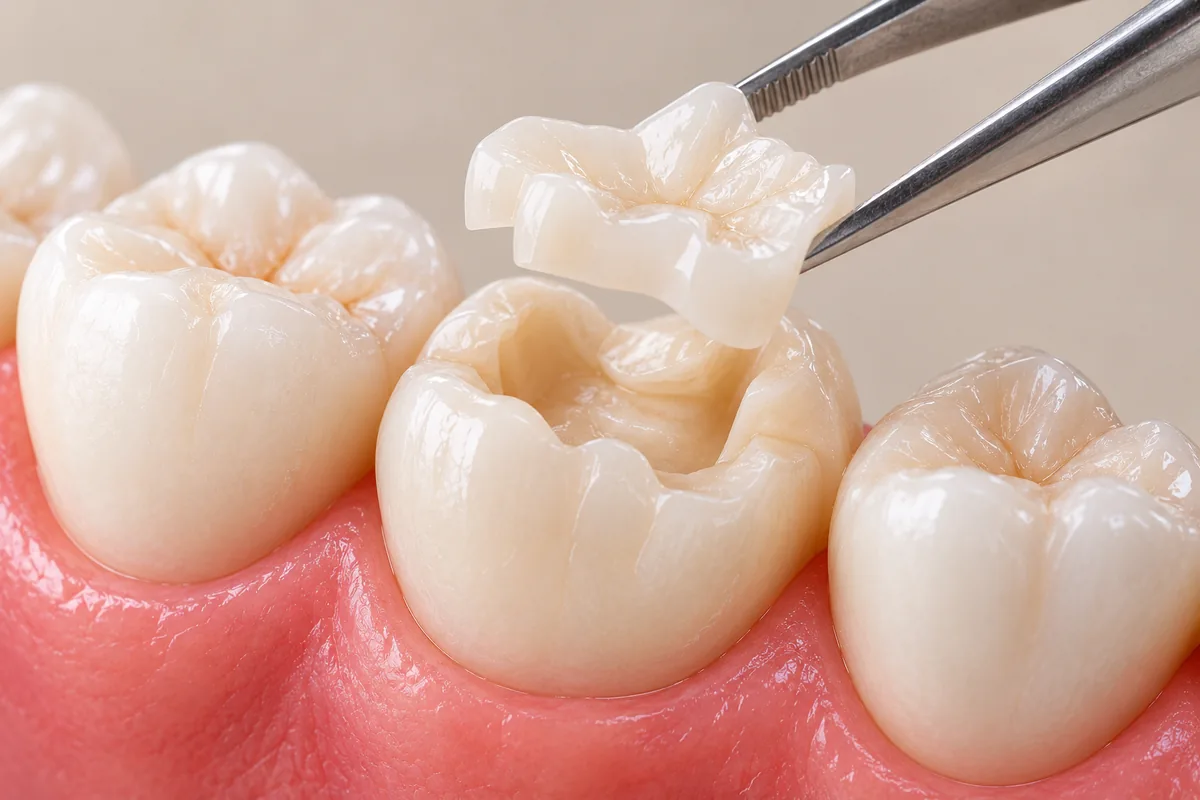
Dental inlays and onlays are custom-made restorations designed to rebuild damaged or decayed portions of a tooth while preserving healthy tooth structure whenever possible.
At Beverly Hills Cosmetic & Implant Center, Dr. Tamir Shams takes a conservative approach to restorative dentistry, selecting treatment according to the amount of healthy tooth structure remaining, location of the damage, bite forces, and long-term needs of the tooth.
The goal is straightforward: restore what needs to be restored while preserving as much healthy natural tooth structure as appropriate.
- What Are Dental Inlays and Onlays?
- When Is an Inlay or Onlay Recommended?
- Inlay vs. Onlay: What’s the Difference?
- Benefits of Dental Inlays & Onlays
- Inlay or Onlay vs. Dental Filling
- Inlay or Onlay vs. Dental Crown
- What Materials Are Used for Inlays and Onlays?
- What to Expect When Getting an Inlay or Onlay
- How Long Do Dental Inlays and Onlays Last?
- Caring for an Inlay or Onlay
- Can an Inlay or Onlay Save a Tooth From Needing a Crown?
A 3D scan, a clear answer on which option fits you, and a written plan with timeline and cost. No obligation.
What Are Dental Inlays and Onlays?
Inlays and onlays are custom dental restorations used to repair teeth affected by decay, fracture, wear, or failing restorations.
Unlike a conventional filling that is placed and shaped directly in the tooth, an inlay or onlay is fabricated to precisely fit the prepared area and then bonded or otherwise secured to the tooth according to the restorative material and treatment plan.
The primary difference between an inlay and an onlay is how much of the tooth the restoration covers.
Dental Inlay
An inlay restores an area primarily contained within the cusps, or raised portions, of a back tooth.
Dental Onlay
An onlay restores a larger portion of the tooth and extends over one or more cusps when those areas also require coverage or protection.
For this reason, onlays are sometimes described as partial-coverage restorations.
When Is an Inlay or Onlay Recommended?
Inlays and onlays may be considered when a tooth has moderate structural damage but still has enough healthy tissue that a full-coverage crown may not be necessary.
They may be used to treat:
- Moderate tooth decay
- Cracked or fractured portions of a tooth
- Worn tooth structure
- Large or failing fillings
- Damaged tooth cusps
- Teeth requiring more support than a conventional filling may provide
The condition of the tooth must be carefully evaluated before choosing a restoration.
If the damage is relatively small, a filling may be sufficient.
If a larger portion of the tooth has been compromised, a dental crown may provide more appropriate coverage and protection.
An inlay or onlay can occupy the restorative space between these two treatments.
Inlay vs. Onlay: What’s the Difference?
The difference primarily involves the amount and location of tooth structure being restored.
An inlay generally fits within the chewing surface of the tooth without covering its cusps.
An onlay extends farther and covers one or more cusps when those areas are weakened, fractured, or require restoration.
The choice is not based on patient preference alone. Dr. Shams evaluates which portions of the tooth require restoration and which healthy areas can appropriately remain intact.
Benefits of Dental Inlays & Onlays
For appropriately selected teeth, inlays and onlays offer several restorative advantages.
Preserve Healthy Tooth Structure
One of their most important benefits is conservation.
Because an inlay or onlay covers only the portions of the tooth requiring restoration, healthy tooth structure that does not need to be removed can often remain intact.
Custom Fit
Inlays and onlays are fabricated specifically for the prepared tooth, allowing the restoration to reproduce its shape and relationship with neighboring and opposing teeth.
Restore Damaged Tooth Structure
An inlay or onlay can rebuild areas affected by decay, fracture, wear, or a failing restoration.
Natural-Looking Appearance
Tooth-colored restorative materials can be selected to complement the appearance of the natural tooth.
Restore the Chewing Surface
Because inlays and onlays are frequently used on premolars and molars, careful attention is given to rebuilding the chewing surface and its relationship with the patient’s bite.
Inlay or Onlay vs. Dental Filling
A dental filling is generally used when the area requiring restoration is relatively limited and sufficient healthy tooth structure remains to support it.
As the size of the damaged or decayed area increases, a direct filling may not always provide the ideal restorative solution.
A custom inlay or onlay may be considered when the tooth requires more extensive reconstruction but does not need complete coverage with a crown.
The decision depends on:
- Size of the damaged area
- Location of the damage
- Condition of the cusps
- Amount of remaining tooth structure
- Existing restorations
- Bite forces
- Risk of future fracture
The objective is to choose the least extensive restoration that can appropriately restore the tooth.
Inlay or Onlay vs. Dental Crown
An inlay or onlay and a dental crown differ primarily in how much of the natural tooth they cover.
Inlay or Onlay
Restores selected areas of the tooth while preserving portions that remain healthy and structurally sound.
Dental Crown
Provides substantially more coverage and is generally used when a tooth has experienced greater structural compromise.
A crown may be recommended when a tooth has:
- Extensive decay
- Significant fracture
- Substantial loss of tooth structure
- Extensive existing restorations
- Structural weakness requiring broader coverage
When the remaining tooth structure is healthy enough to preserve, an inlay or onlay may provide a more conservative alternative.
What Materials Are Used for Inlays and Onlays?
Inlays and onlays can be fabricated from different dental materials depending on the tooth, location, bite, aesthetic requirements, and restorative needs.
Tooth-colored ceramic materials are commonly used because they can provide a combination of function and aesthetics.
Other restorative materials may also be appropriate depending on the clinical situation.
Because we select restorations according to the individual tooth, the recommended material should consider:
- Tooth location
- Remaining tooth structure
- Bite forces
- Restoration thickness
- Cosmetic requirements
- Opposing teeth
- Grinding or clenching habits
Dr. Shams can explain which restorative material is appropriate for your tooth and why.
What to Expect When Getting an Inlay or Onlay
Dental Evaluation
Dr. Shams examines the tooth and surrounding structures to determine the extent of decay, damage, or existing restorative material.
Dental imaging may be used when necessary to evaluate areas that cannot be fully assessed visually.
Tooth Preparation
Decay and compromised restorative material are removed as appropriate.
The tooth is then conservatively prepared according to the planned inlay or onlay while preserving healthy tooth structure whenever possible.
Impression or Digital Records
Detailed records of the prepared tooth and surrounding teeth are obtained so the custom restoration can be fabricated.
Temporary Restoration When Needed
Depending on the treatment process, a temporary restoration may be used to protect the tooth while the final inlay or onlay is being created.
Final Placement
The completed restoration is evaluated for:
- Fit
- Shape
- Contact with neighboring teeth
- Bite
- Margins
- Appearance
After appropriate adjustments, the inlay or onlay is secured to the tooth.
How Long Do Dental Inlays and Onlays Last?
Inlays and onlays are designed to provide long-term restoration of appropriately selected teeth, but their lifespan varies.
Factors that can affect longevity include:
- Oral hygiene
- Amount of remaining tooth structure
- Bite forces
- Teeth grinding or clenching
- Restorative material
- Diet and habits
- Gum health
- Tooth location
- Professional dental maintenance
The natural tooth surrounding the restoration remains susceptible to decay and other dental problems.
Routine examinations allow the restoration and underlying tooth to be monitored over time.
Caring for an Inlay or Onlay
An inlay or onlay generally does not require complicated maintenance.
Good daily care includes:
- Brushing regularly
- Flossing around the restored tooth
- Maintaining routine dental examinations
- Receiving professional cleanings
- Avoiding chewing ice and other extremely hard objects
- Avoiding using teeth as tools
- Managing grinding or clenching when present
Patients with significant nighttime grinding may be advised to use a protective nightguard.
Can an Inlay or Onlay Save a Tooth From Needing a Crown?
Sometimes—but not always.
When enough strong, healthy tooth structure remains, an inlay or onlay may restore the damaged portion without covering the entire tooth.
This can make treatment more conservative than a full dental crown.
However, if the tooth is extensively weakened, fractured, or compromised, a crown may provide more appropriate protection.
The goal should not be to avoid a crown at all costs. It should be to choose the most conservative restoration that can appropriately address the tooth’s structural and functional needs.
Frequently Asked Questions About Inlays & Onlays
A dental inlay is a custom restoration used to repair a damaged or decayed portion of a tooth primarily within its cusps. It may be recommended when the tooth requires more restoration than a conventional filling but does not need broader coverage.
A dental onlay is a custom restoration that rebuilds a larger portion of the tooth and covers one or more cusps. It can provide additional coverage while preserving healthy areas that do not require a full crown.
An inlay generally fits within the cusps of a tooth, while an onlay extends over one or more cusps. The appropriate restoration depends on the location and extent of the damaged tooth structure.
No. An onlay provides partial coverage and preserves portions of healthy natural tooth structure. A crown surrounds substantially more of the tooth and is generally used when more extensive structural restoration is necessary.
Not necessarily. A filling may be the most appropriate treatment for a smaller area of decay or damage. An inlay may be considered when the area requiring restoration is larger or when a custom restoration provides advantages for that particular tooth.
In certain cases, an onlay can restore a tooth while preserving enough healthy structure that a full crown is unnecessary. However, significantly weakened or damaged teeth may still require a crown.
They can be. Tooth-colored ceramic materials are commonly used for inlays and onlays. The appropriate material depends on the tooth, bite forces, location, aesthetic requirements, and treatment plan.
Inlays and onlays are designed as long-term restorations, but longevity varies according to oral hygiene, bite forces, remaining tooth structure, grinding or clenching, restorative material, habits, and professional maintenance.
Restore Your Tooth While Preserving Healthy Structure
A damaged tooth does not automatically require a full dental crown.